
- New system at KRAIBURG TPE enables collection of precise data on the fluidity, surface quality, and adhesion of specific material compounds.
- This makes fulfilling customer requirements even more efficient.

The clear advantage of this tool design is its flexibility when investigating significant material data. This enables new TPE compounds to be examined more accurately.
Dipl. Ing. (FH) Grit Müller | Application Engineering
KRAIBURG TPE has implemented a new system at the production facilities at its main site in Waldkraiburg, Bavaria. It enables quick changeover between temperature-controlled tooling inserts in injection molding processes in order to gain precise data on the fluidity, surface quality, and adhesion of specific material compounds. This makes fulfilling customer requirements more efficient.
As demand for materials is increasing constantly, there is a need for continual development and innovation in materials and testing. We have learned through experience that a standard test plate is of limited use when validating materials. Aspects like fluidity and surface quality are also important in addition to mechanics. In order to cater for these situations and to satisfy customer requirements, KRAIBURG TPE decided to provide different bonding options for each product design. Tools are attached to a new injection molding machine with a locking force of 1,100 kN. They are primarily used for internal Thermoplastic Elastomer (TPE) testing and for preparing test and sample plates of commercial or customer-specified TPE compounds for specialist material testing.
Intelligent sensor technology delivers reproducible data. This information improves the analysis of the injection qualities of the compounds when used in various gating systems. Various surfaces can also be created and analyzed through the use of different tooling inserts. EPDM bonding can also be evaluated according to Guideline 2701 of the Trade Association for the German Rubber Industry (WDK) which was adopted in 2019. This enables both the internal and external requirements of the material to be mapped. Areas that can benefit from this:
- Surface structures for vehicle interiors
- Evaluating the demolding properties of super soft compounds
- Determining the actual cavity pressure.
"The clear advantage of this tool design is its flexibility when investigating significant material data," says Dipl. Ing. (FH) Grit Müller from the Application Engineering Team at KRAIBURG TPE. "This enables new TPE compounds to be examined more accurately."
The system and interchangeable inserts were developed and created in collaboration with Konstruktionsbüro Hein (www.kb-hein.de) and Monz Werkzeugbau (www.werkzeugbau.com). It was a challenge to integrate the various gating systems with the shortest possible set-up times. The inserts are designed for the production of application-specific sample plates. The design is flexible and can also be adapted to fulfill new requirements in future.
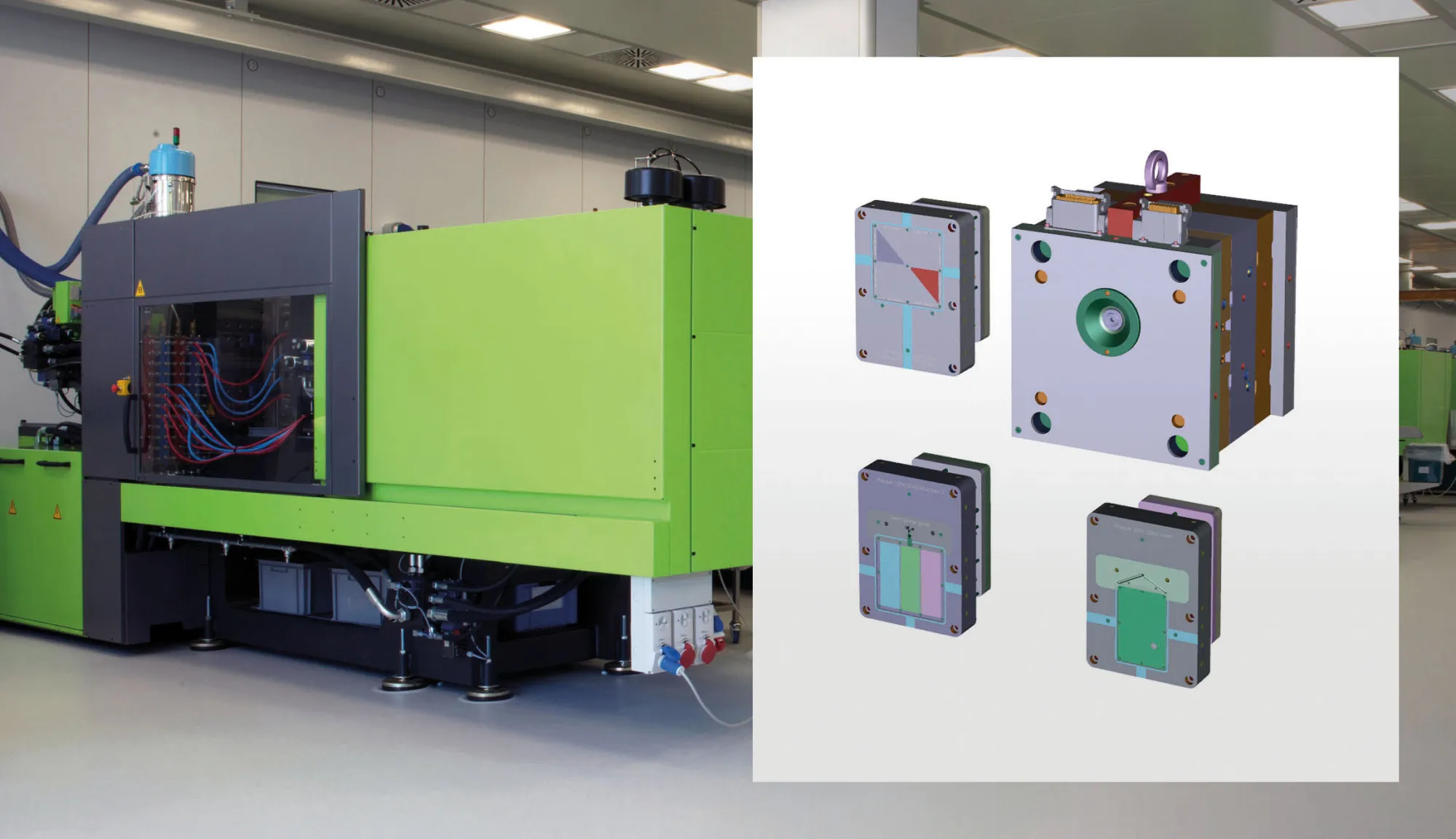
Image: A new system at the main production site of KRAIBURG TPE enables quick changeover between temperature-controlled tooling inserts in injection molding processes in order to gain precise data on the fluidity, surface quality, and adhesion of specific material compounds. (© KRAIBURG TPE)
Significant materials data from injection to surface qualities and adhesion
- New system at KRAIBURG TPE enables collection of precise data on the fluidity, surface quality, and adhesion of specific material compounds.
- This makes fulfilling customer requirements even more efficient.

The clear advantage of this tool design is its flexibility when investigating significant material data. This enables new TPE compounds to be examined more accurately.
Dipl. Ing. (FH) Grit Müller | Application Engineering
KRAIBURG TPE has implemented a new system at the production facilities at its main site in Waldkraiburg, Bavaria. It enables quick changeover between temperature-controlled tooling inserts in injection molding processes in order to gain precise data on the fluidity, surface quality, and adhesion of specific material compounds. This makes fulfilling customer requirements more efficient.
As demand for materials is increasing constantly, there is a need for continual development and innovation in materials and testing. We have learned through experience that a standard test plate is of limited use when validating materials. Aspects like fluidity and surface quality are also important in addition to mechanics. In order to cater for these situations and to satisfy customer requirements, KRAIBURG TPE decided to provide different bonding options for each product design. Tools are attached to a new injection molding machine with a locking force of 1,100 kN. They are primarily used for internal Thermoplastic Elastomer (TPE) testing and for preparing test and sample plates of commercial or customer-specified TPE compounds for specialist material testing.
Intelligent sensor technology delivers reproducible data. This information improves the analysis of the injection qualities of the compounds when used in various gating systems. Various surfaces can also be created and analyzed through the use of different tooling inserts. EPDM bonding can also be evaluated according to Guideline 2701 of the Trade Association for the German Rubber Industry (WDK) which was adopted in 2019. This enables both the internal and external requirements of the material to be mapped. Areas that can benefit from this:
- Surface structures for vehicle interiors
- Evaluating the demolding properties of super soft compounds
- Determining the actual cavity pressure.
"The clear advantage of this tool design is its flexibility when investigating significant material data," says Dipl. Ing. (FH) Grit Müller from the Application Engineering Team at KRAIBURG TPE. "This enables new TPE compounds to be examined more accurately."
The system and interchangeable inserts were developed and created in collaboration with Konstruktionsbüro Hein (www.kb-hein.de) and Monz Werkzeugbau (www.werkzeugbau.com). It was a challenge to integrate the various gating systems with the shortest possible set-up times. The inserts are designed for the production of application-specific sample plates. The design is flexible and can also be adapted to fulfill new requirements in future.
Press Europe, Middle East, Africa
Juliane Schmidhuber
PR & Communications Manager

凱柏膠寶 - 快覽
- 總部與生產基地:瓦爾德克賴堡/德國
- 區域總部和生產基地:吉隆坡/馬來西亞,亞特蘭大/美國
- 產品:熱塑性彈性體化合物
- 品牌:熱塑寶、科柔寶、高溫寶和尼塑寶
- 市場:歐洲、美洲、亞太地區
- 員工:660