

Publikace: 03. Srpen 2026 Poslední aktualizace: 07. Srpen 2026

TPE for Food Contact 

Why Material Selection and Migration Testing Go Hand in Hand


In our blog post, written by our colleague Dirk Olberding, Market Manager for Consumer Products, you’ll learn what to consider when thermoplastic elastomers are used in direct contact with food. What regulations apply in the EU, and what does this mean for processors and, above all, for manufacturers of end products? 

TPE in Food Contact Applications – Why Material Selection and Migration Testing Go Hand in Hand  

We encounter thermoplastic elastomers (TPE) more often in everyday life than many people realize. Seals in food storage containers, dough scrapers, lids on coffee cups or cereal bowls, foldable salad bowls, slit valves in packaging for sauces or sweeteners, as well as hoses and sealing elements in coffee machines – numerous products that come into daily contact with food contain soft and flexible TPE components.

These applications place high demands on the material. In addition to properties such as elasticity, sealing performance, a pleasant feel, or reliable adhesion to hard plastics, one thing is paramount: the safety of end consumers. Each and every one of us comes into contact with these products every day—an important reason, then, to take a closer look. After all, for plastics to be used safely and durably in food contact applications, they must meet strict regulatory requirements. Read on to find out exactly what this means for thermoplastic elastomers.

Safety Starts with Legal Requirements

In Europe, Regulation (EU) No. 10/2011 serves as the authoritative basis for plastic materials intended to come into contact with food. It regulates plastic materials and articles that come into contact with food and harmonizes the requirements within the European Union.

The aim of the regulation is to ensure that, under the intended conditions of use, no substances from the plastic migrate into food that could endanger health or impermissibly alter the composition or taste of the food. For manufacturers of end products, this means that, in addition to a material’s functional properties, its regulatory compliance must also be taken into account as early as the product development stage.

Technical properties alone are not sufficient

The selection of a suitable TPE is therefore always based on multiple criteria. For example, the material must provide a reliable seal, be cost-effective to process, demonstrate secure adhesion to a rigid component where necessary, and simultaneously meet the desired tactile properties.

Equally crucial, however, is whether the compound used meets the requirements of Regulation (EU) No. 10/2011 for the specific application. Technical performance and regulatory compliance cannot be separated when it comes to food contact. For this reason, the evaluation of suitable materials begins well before actual series production.

Explore more about TPE for Food Contact 

Controlled Migration TPE for Food Contact & Packaging Applications.
 

show More

Component Design Influences Migration

A frequently underestimated factor is the design of the component itself. The migration behavior of a plastic does not depend solely on the material but is also influenced by the geometry of the application.

Of particular importance here is the ratio between the container’s capacity and the surface area of the TPE that actually comes into contact with the food. A small container with a large contact area has a less favorable surface-to-volume ratio than a large container with a small contact area.
Even during the development phase, a well-thought-out component design can therefore help reduce migration and ensure that subsequent testing is more successful. Material development and design should therefore be considered together as early as possible.

Migration tests are an indispensable part of product development

Responsibility for the conformity of the finished product lies with the manufacturer or the company that places the end product on the market. For this reason, Regulation (EU) No. 10/2011 requires migration tests to be conducted on the finished component within the EU.

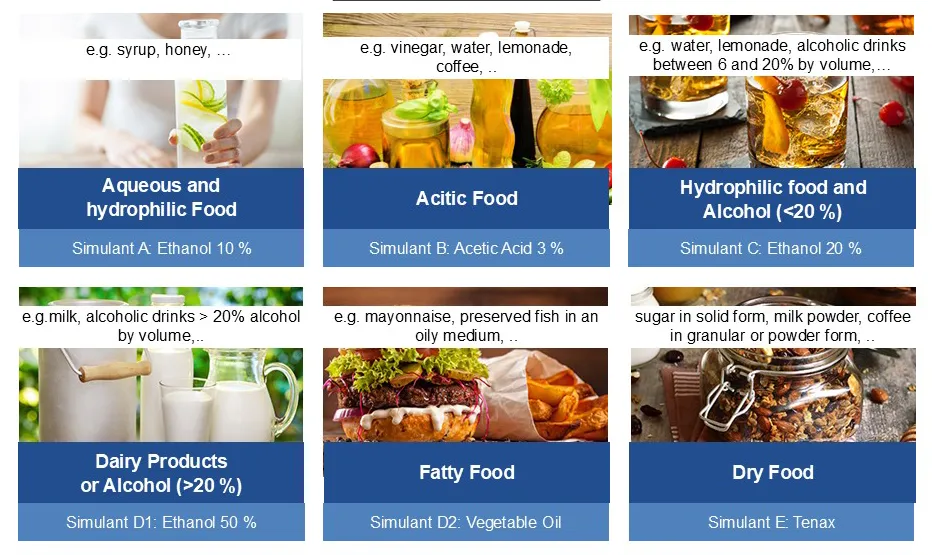
The test conditions applied depend largely on the types of food the product will later come into contact with and the conditions under which it will be used. For this purpose, so-called food simulants (which represent different food groups) and standard test conditions are used for the overall migration test. 

Fatty foods pose particular challenges

For applications involving fatty foods, Regulation (EU) No. 10/2011 specifies simulant D2 (vegetable oil). However, this test leads to a unique situation, particularly with TPEs.

Due to the polarity of the TPE, the D2 test simulant migrates into the material during the test. However, to definitively determine which substances migrate from the thermoplastic elastomer into the test medium, the medium would subsequently have to be completely extracted. Since this is technically very challenging and often leads to non-reproducible results, the regulation provides for an alternative test using the alternative simulants isooctane and 95% ethanol.

However, these present their own challenges. The use of isooctane causes a physical change in the thermoplastic elastomer. Since this is not permitted under Regulation (EU) No. 10/2011, the results may not be used for conformity assessment purposes. 95% ethanol, on the other hand, has only a very minor effect on the TPE, and the migration results for controlled migration compounds are stable and do not underestimate the actual migration. For other compounds, the low extraction power of 95% ethanol may lead to an underestimation of the actual migration.

For such cases, Regulation (EU) No. 10/2011 expressly allows for the qualification of alternative simulants using a “screening approach.” In this context, KRAIBURG TPE has identified an alternative simulant and, as required, scientifically demonstrated that it can be used for TPE migration testing. This allows for realistic conclusions to be drawn about migration behavior while simultaneously avoiding unnecessary misinterpretations or time-consuming repeat testing.

Successful projects result from early collaboration

The development of safe applications for repeated food contact thus begins long before the actual migration test. The key lies in the interplay between a suitable material selection, a well-thought-out component design, and a testing strategy that corresponds to the subsequent conditions of use. This is precisely where KRAIBURG TPE’s many years of expertise come into play.

Thanks to extensive experience with food contact applications, in-depth expertise in migration testing, and the identification of an alternative test simulant for fatty foods in accordance with (EU) No. 10/2011, we can support customers from the earliest stages of a project. This minimizes development risks, avoids unnecessary testing loops, and efficiently guides products to market readiness.

After all, the successful use of a TPE in repeated direct food contact is always the result of a holistic approach—from design and material selection to the appropriate testing strategy.

Gain insights from the Experts

Webinar: Controlled Migration TPE with polar adhesion

Discover our special series – your advanced material solution for direct food contact, cosmetic, and other applications with high regulatory requirements. In this webinar, we will introduce a versatile range of materials designed to meet strict global standards while delivering outstanding performance.

Take advantage of the free 25-minute webinar to get a quick and up-to-date overview of the topic. Please contact us if you would like to discuss this topic in person.
 

View webinar