

Публикация: 23. июня 2026

News & Blog

Thermosets, Thermoplastics, Elastomers, and Thermoplastic Elastomers—A Comparison of Polymer Classes  


Despite all the criticism, plastics have become an indispensable part of our everyday lives. There is hardly any area where we do not encounter them—whether in vehicles, household appliances, medical products, packaging, or technical industrial applications. However, the umbrella term “plastic” encompasses a wide variety of different materials with very different properties. Their behavior is determined by the molecular structures of the polymers used. In our blog post newsletter, Oliver Lippert, a product developer at KRAIBURG TPE, will explain exactly what this means and what properties duromers, thermoplastics, elastomers, and thermoplastic elastomers possess.
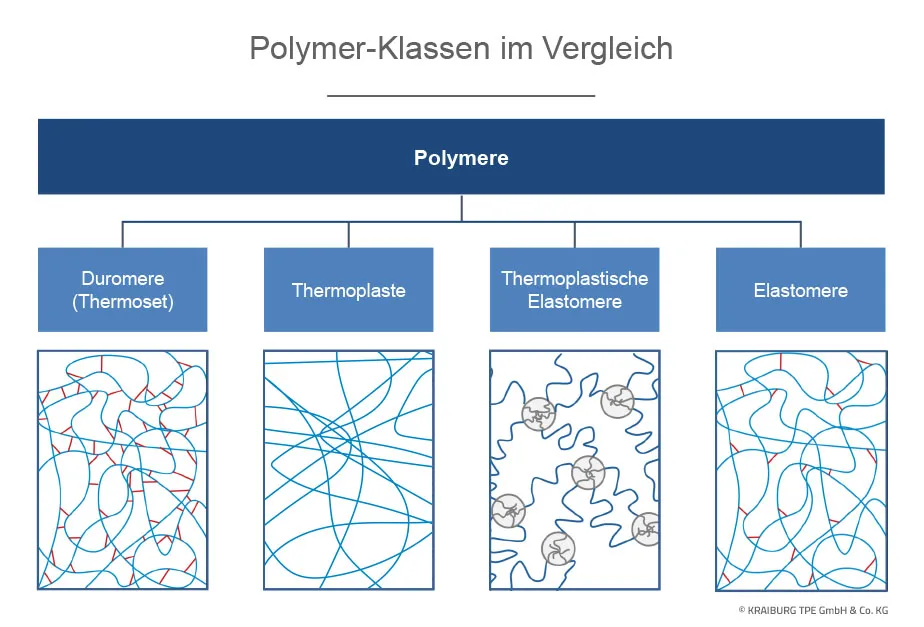
A Comparison of Polymer Classes


Despite all the criticism, plastics have become an indispensable part of our everyday lives. There is hardly any area where we do not encounter them—whether in vehicles, household appliances, medical products, packaging, or technical industrial applications. 

However, the umbrella term “plastic” encompasses a wide variety of different materials with very different properties. Their behavior is determined by the molecular structures of the polymers used. In this newsletter, I’ll explain exactly what that means and describe the properties of duromers, thermoplastics, elastomers, and thermoplastic elastomers.

Essentially, the modern world of plastics can be divided into four major material classes: thermoplastics, duromers, elastomers, and thermoplastic elastomers. Each of these groups is characterized by distinct properties that make them particularly suitable for specific applications. An overview and understanding of these properties help in selecting the right materials for specific purposes and making optimal use of their potential.

Thermoplasts – Versatile Material Groups


Thermoplasts represent the largest group of plastics in use. Their polymer chains are linear or only slightly branched, and there is no chemical cross-linking between the individual molecular chains. This structure causes thermoplasts to soften when heated and eventually melt. As they cool, they solidify again and retain their new shape. This process can be repeated multiple times without altering the underlying structure or their mechanical properties

A key advantage of thermoplastics lies in their processing options: injection molding, extrusion, and blow molding are ideal for shaping thermoplastics into the desired form. Cost-effective production of large quantities is possible. In addition, many thermoplastics can be remelted and reprocessed multiple times, which enhances their recyclability.

Typical plastics in this material class include polyethylene (PE), polypropylene (PP), and polyamides (PA). They are used, among other things, in packaging, bottles, pipes, engineering components, and automotive parts.

Duromers – Dimensionally Stable Even Under High Stress


Duromers, also known as thermosets, differ fundamentally from thermoplastics. Their polymer chains are permanently cross-linked through numerous chemical bonds, creating a three-dimensional network that gives the material its high stability. 

These materials are cross-linked through a curing process. Once this chemical reaction is complete, the shape can no longer be altered. Unlike thermoplastics, duromers do not melt at high temperatures. Above a certain temperature, they decompose. 

Permanent cross-linking results in high stiffness, hardness, and temperature resistance. Duromers retain their shape even under thermal stress and exhibit good chemical resistance.

Typical applications include electrical insulation components, printed circuit boards, adhesives, coatings, and heat-resistant housings. Well-known examples include epoxy resins, phenolic resins, and melamine resins.

However, the high degree of cross-linking also has disadvantages. Duromers are comparatively brittle and cannot be easily recycled. Remelting or reshaping is not possible.

Elastomers – Flexible and Resilient


Elastomers form another class of plastics. Their polymer chains are also cross-linked, but to a much lesser extent than in duromers. This low degree of cross-linking enables a unique property: elastomers can be severely deformed and return to their original shape once the stress is removed. 

When an application requires a high degree of flexibility and elasticity, we turn to elastomers. Although elastomers soften at high temperatures, they do not melt like thermoplastics. Cross-linking ensures stability. However, if the thermal load is too high, the material begins to age or degrade.

Typical applications include tires, seals, hoses, O-rings, and vibration dampers. Well-known elastomers include natural rubber, EPDM, NBR, and silicone rubber.

Due to chemical cross-linking, the recyclability of traditional elastomers is limited. Recycling is significantly more complex than with thermoplastics.

Thermoplastic Elastomers – The Fusion of Two Product Groups

Another group of materials has established itself between thermoplastics and traditional elastomers: thermoplastic elastomers (TPE). TPEs combine the elastic properties of elastomers with the processing advantages of thermoplastics. Their unique chemical structure—depending on the specific TPE class—is based on physical cross-linking rather than permanent chemical cross-linking. As a result, they exhibit elastic behavior in applications but can be repeatedly remelted and molded. 

This combination enables cost-effective manufacturing processes while delivering flexible product properties. Typical applications range from soft-touch surfaces to seals, cable jackets, and shoe soles. A key feature is their ability to bond to other thermoplastics, which is combined with cost-effective processing in multi-component injection molding.


Within the TPE family, there are various material classes, including TPS, TPU, TPV, TPO, TPC, and TPA. You can find more information about the different TPE classes here. They differ in terms of their morphology, temperature resistance, and mechanical properties, thereby covering a broad spectrum of applications.

Conclusion: Every polymer class has its place


Thermoplastics, duromers, and elastomers—as well as thermoplastic elastomers—follow different technical approaches and meet different requirements. Thermoplastics stand out for their processability and recyclability, duromers for their high dimensional stability and temperature resistance, and elastomers for their exceptional elasticity.

Thermoplastic elastomers represent another material group that combines properties from different polymer families.

Which material class is the right choice ultimately always depends on the requirements of the specific application. There is no one-size-fits-all “best” solution. Rather, all polymer classes have their place and contribute to meeting the diverse requirements of modern products and technologies. Daily innovations within the individual product classes are expanding the possibilities. And we at KRAIBURG TPE are pleased to play our part. 

Which products do you work with, and what experiences would you like to share? We look forward to exchanging ideas with you. Feel free to write your thoughts in the comments.

Author

Gain insights from the Experts

Webinar
Thermoplastic Elastomers: The Basics

This 30-minute introductory session aims at TPE beginners as well as advanced users, and will focus on different TPE classes, (dis-)advantages of TPS materials, attributes of TPS as well as its composition.
 

View Webinar